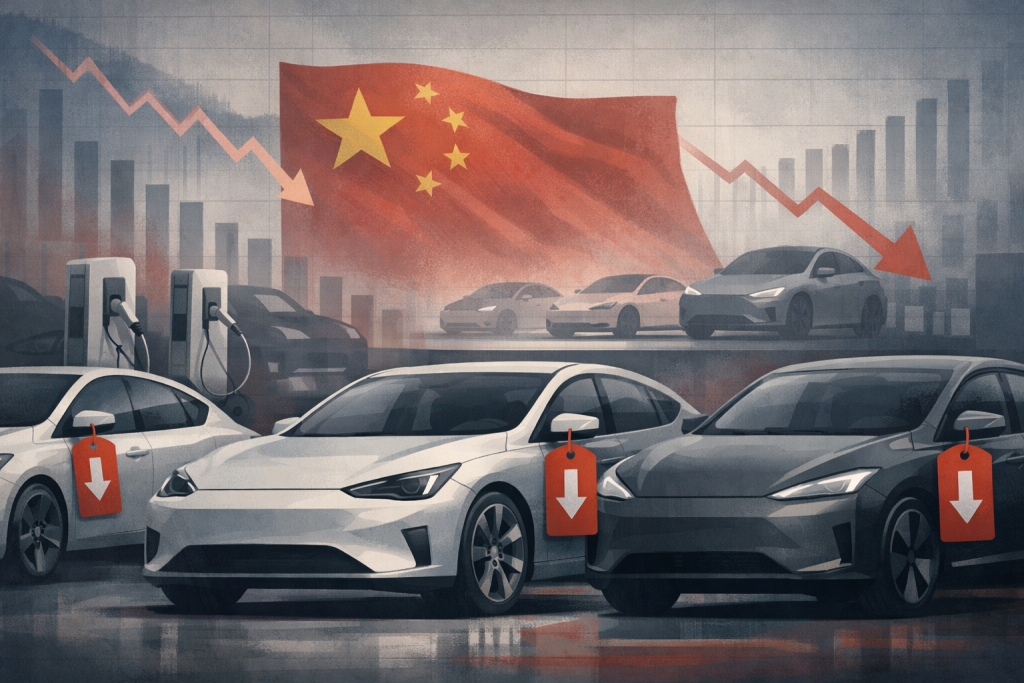
China’s electric vehicle (EV) boom is losing momentum in 2025, with sales declining across major players and analysts warning that the intense price war is likely to persist.
While overall adoption remains high, slowing domestic demand, rising market concentration, and shifting policy support are reshaping the world’s largest auto market.
Sales dip as competition intensifies
Data from the China Passenger Car Association shows that sales momentum weakened through most of the year.
Tesla’s China sales fell 7.4% year-on-year between January and November, while market leader BYD reported a 5.1% decline over the same period.
BYD’s slowdown was particularly pronounced in November, when passenger car sales dropped 26.5% from a year earlier.
In contrast, newer entrants posted rapid growth.
Models powered by Huawei software and vehicles from Xiaomi recorded sales increases of more than 90% in November, underscoring how competition is shifting toward tech-driven challengers.
The early wave of US-listed Chinese EV startups — Nio, Xpeng, and Li Auto — failed to make the top 10 sellers for the month, despite improvements in deliveries.
Market concentration has risen sharply.
The top 10 manufacturers now account for around 95% of China’s new energy vehicle market, compared with roughly 60% to 70% just two to three years ago, according to Citic CLSA.
Analysts expect further consolidation as buyers gravitate toward well-known brands amid mounting price pressure.
Price war set to continue
Aggressive discounting has become a defining feature of the market.
Autohome, a Chinese online auto platform, now lists vehicles by discount size, highlighting cuts such as a 432,000 yuan reduction on the Mercedes-Benz EQS EV and a 147,000 yuan cut on the Volvo XC70.
Paul Gong, head of China autos research at UBS, expects the price war to continue “for years.”
He also warned that policy changes could weigh on growth in 2026, with Beijing planning to re-impose a purchase tax and scale back trade-in subsidies.
UBS forecasts that China’s EV sales growth rate could roughly halve next year from around 20% in 2025.
Despite the slowdown, the market is already highly saturated.
New energy vehicles — including battery-electric and hybrid models — accounted for 59.4% of new passenger car sales in November, underscoring limited room for further rapid expansion at home.
Overseas expansion and foreign competition
Slowing domestic demand is pushing Chinese automakers to accelerate overseas expansion, where margins are often higher.
Geely said its EV exports quadrupled in the first half of the year, helping drive total vehicle exports to 184,000.
The company has entered markets such as Australia and Vietnam and expanded its footprint to around 90 countries, while opening factories in regions including Egypt, the Middle East, and Indonesia.
BYD is also scaling its international presence, with a new factory in Hungary set to ramp up production in 2026.
The company exported more than 131,000 cars in November alone.
Analysts expect Chinese manufacturers and battery makers to intensify competition in Europe, bringing pressure closer to US automakers and Tesla.
Foreign brands remain committed to China despite the challenges.
Volkswagen has formed joint ventures with Xpeng and Horizon Robotics and operates its largest R&D center outside Germany in Hefei.
In the first three quarters of 2025, Volkswagen delivered more than 17 million vehicles in China, up 8.5% year-on-year, far exceeding its deliveries in Western Europe.
China’s auto market remains lucrative but unforgiving. As one analyst noted, dominance can be fleeting, with leaders quickly forced to play catch-up in a market defined by rapid change and relentless competition.
The post China’s EV market slows as price war deepens and overseas push accelerates appeared first on Invezz